



Last updated July 2026
You accepted the offer. Take a moment, that decision took real courage, and thousands of students never get past wanting it.
Then a new list appears. Where will you live? What goes in the suitcase? When should you fly? How do you find a job once you land? And who do you call when something goes sideways at 2 a.m. local time?
This manual answers the practical questions that fill the months between acceptance and your first weeks abroad. Housing, packing, working, your first-week checklist, and the things past students wish someone had told them. Read it once now, then come back to it as each stage arrives.
Your Timeline From Acceptance to Arrival
The week you accept: apply for housing. Not soon, that week. University accommodation is limited and allocated first-come, first-served, and the students who apply immediately get the best rooms at the best prices. Start your visa or registration paperwork at the same time; each destination works differently, and our country guides walk through every step.
Two to three months out: confirm your accommodation in writing and note exactly what the deposit and first payment require. Arrange your health cover, book flights once your entry permission is sorted, and build your arrival fund, enough accessible money to cover deposits plus your first four to eight weeks of living costs.
One month out: pack (guidance below), photocopy your key documents, confirm your Canadian cards will work abroad, and check whether your bank abroad lets you start the account opening online.
Arrival week: follow the first-week checklist later in this guide. Everything on it exists to get you settled, connected, and eligible to work as quickly as possible.
Where Will You Live?
Housing is the question we hear most from students and parents alike, and after guiding thousands of students through it, we can tell you the process rewards early movers far more than clever ones. Start with one decision: on campus, or off?
On-campus housing: the easy first year
Living on campus puts you steps from class and the middle of student life. Utilities are usually included in your fees, so your costs are known in advance, and many residences offer optional meal plans. Room configurations vary by school, single rooms, shared rooms, singles with private washrooms, so check your university’s accommodation website for the full menu.
For most first-year international students, this is the answer we recommend. One application, one payment, zero landlords, and instant neighbours.
Off-campus housing: independence with homework
Prefer your own space, a downtown flat, or a place near the beach? Off-campus living offers freedom, with two contract details that deserve close attention before you sign anything.
Rent usually excludes utilities. Internet, electricity, heat, and water arrive as separate bills. Confirm every cost with the landlord before signing.
Watch the lease length. Some landlords require a 12-month agreement even though your academic year runs nine. That gap is three months of rent, either budget for it, negotiate, or look for academic-year contracts.
A few warning signs worth knowing: a landlord who wants a deposit before you (or someone you trust) has seen the property, pressure to pay in cash, and rent dramatically below everything comparable. When in doubt, send the agreement to your university’s accommodation office, reviewing private rentals and flagging problems is part of their job, and they know the local market street by street.
Homestay: a soft landing
For students finishing high school and leaving home for the first time, homestay places you with a local family in their house, meals, conversation, and a built-in guide to the neighbourhood while you find your feet. Many students stay in touch with their host families for years afterward.
How to lock it in
Once you have chosen your school, go straight to the accommodation office through the university website. They provide the housing options, the application instructions, and the deadlines. Arranging accommodation before arrival is ultimately your responsibility, and we partner with student housing providers precisely so that no KOM student lands without a confirmed place to sleep. If you hit a wall at any point, contact us and we will connect you with the right people.
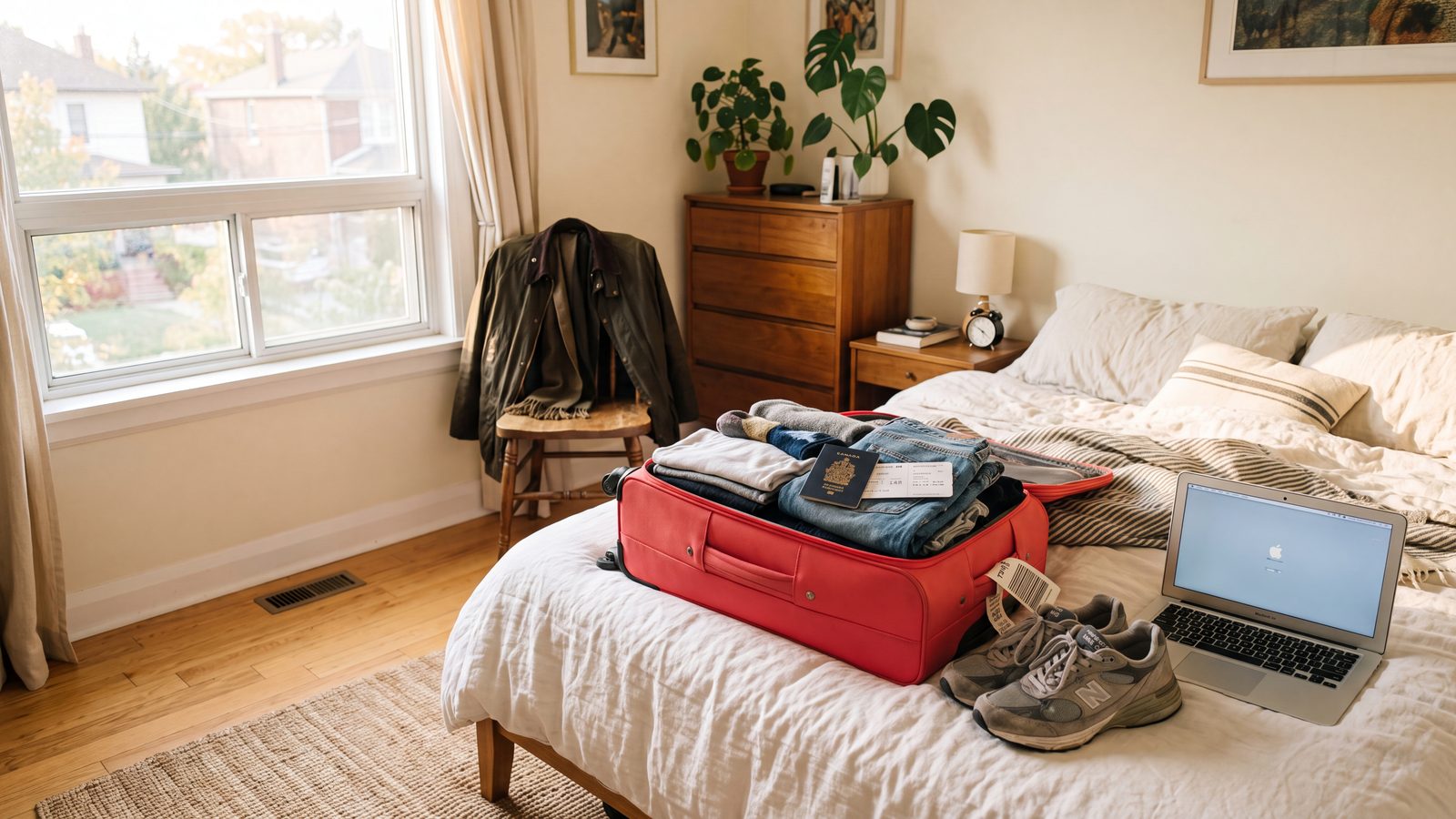
What Should You Pack?
Packing for a year abroad feels enormous until you realize one thing: you are moving to a country with shops. Pack the essentials, and buy the rest after you land.
Documents (carry-on only, always)
Passport, and your visa or entry documents if applicable
Offer letter and enrolment confirmation
Accommodation details
Travel and medical insurance documents
Copies of academic records, if required
Emergency contact information
Proof of finances, if applicable
Border officers ask for these at the desk. Your checked suitcase will be under the plane. Every document lives in your carry-on, no exceptions.
Clothing
Pack for the climate and seasons you will meet, then stop. Everyday wear for classes, a warm jacket or layers if you are heading somewhere cool, comfortable walking shoes, rain gear where it rains (looking at you, Ireland and the UK), and one semi-formal outfit for events or interviews. Everything else can be bought there, often cheaper than the checked-baggage fee for hauling it.
Health and personal items
A starter supply of toiletries, full sizes exist abroad
Prescription medications with copies of the prescriptions. Many destinations allow up to a three-month supply, but rules vary by country and medication, so confirm before you travel and carry a doctor’s letter for anything unusual.
Basic first-aid items
Glasses or contact lenses, plus a backup pair and your optical prescription
Tech
Laptop and charger, phone and charger, headphones, portable storage, and a travel adapter. One detail saves money and smoke: Australia, the UK, and Ireland all run on 230-volt power (Canada uses 120V). Laptops and phone chargers are dual-voltage and only need a plug adapter, the UK and Ireland share one plug type, Australia uses another. Single-voltage appliances like hair dryers and straighteners generally are not compatible; leave them home and buy locally.
Packing mistakes we see every year
Bringing bedding. Most student accommodation is furnished, and sheets are bulky. Buy bedding after you arrive, it is our single most-repeated packing tip.
Packing documents in checked luggage. See above. It happens every September.
Overpacking clothes. You will wear a third of them and buy new ones anyway.
Bringing 120V appliances. They fail, sometimes dramatically, on 230V power.
Skipping the airline’s baggage rules. Check your allowance before you zip anything; overweight fees at the airport cost more than shipping.
How Does Working While You Study Work?
A part-time job covers groceries, your phone, and your weekends, real money, and never the money your rent depends on. Our Financial Handbook explains where work fits within a complete funding plan. This section covers the practical side: your hours, your paperwork, and where the jobs are.
Your work rights attach to your student status automatically. The limits at a glance:
| Destination | Term-time limit | Break periods | Tax registration |
|---|---|---|---|
| Australia | 48 hours per fortnight | Unlimited during scheduled breaks | Tax File Number (TFN) |
| United Kingdom | 20 hours per week | Full-time during vacations | National Insurance number |
| Ireland | 20 hours per week | Up to 40 hrs/week: Jun 1 – Sep 30 and Dec 15 – Jan 15 | PPS number (requires your IRP first) |
Country-specific detail lives in each destination guide. Two rules travel everywhere: your enrolment and attendance come first, and every hour you work must fit inside your permission, employers abroad check.
Sort the tax paperwork early
Each country requires a tax registration before wages can be paid properly, a TFN in Australia, a National Insurance number in the UK, a PPS number in Ireland. All are free to obtain. Apply in your first two weeks, because employers can rarely finalize your pay without one, and in Ireland you need your residence permit before you can start at all.
Where students find jobs
Campus first: university job boards, the library, student ambassador roles, and research assistant postings are built around class schedules. Off campus, hospitality and retail near universities hire in waves each September and genuinely expect international students. Orientation week job fairs exist for exactly this, bring a simple one-page CV in the local format, which your university’s career service will happily help you write.
Your First Week Checklist
Get a local SIM card first. Nearly everything below wants a local number.
Open (or activate) your bank account and transfer your living funds from Canada.
Load a transport card and learn the route between home and campus before day one of classes.
Start your official registrations: book your immigration appointment in Ireland, register with a GP in the UK, apply for your TFN in Australia.
Attend everything during orientation. Every session, every social, every campus tour. This one week produces most of your first-term friendships, your job leads, and your knowledge of where help lives.
Do a proper first grocery shop and note what staples cost, this becomes your budget baseline.
Walk your campus support services: find the international office, the health centre, and the accommodation office in person, before you need any of them.
What Students Wish They Knew
The first month costs the most, by far. Deposits, first rent, bedding, a stocked kitchen, and setup fees all land within weeks. Students who arrive with a separate arrival fund sail through it; students who arrive with exactly one month’s budget start their adventure stressed.
Week three is the hard one. The novelty fades before the routines form, and a wave of homesickness around then is so common it is almost a schedule. It passes, faster for students who joined things in week one. Homesickness comes in waves, and waves recede.
Say yes to everything for the first month. Clubs, society sign-up fairs, floor dinners, the sport you have never played. Friend groups form early and around shared activity, and the invitations are densest at the start.
You already paid for the support services. Counselling, health care, academic writing help, career advice, your student fees fund all of it. Using these services is normal, common, and free; the students who thrive are usually the ones who ask for help early.
Cooking is the biggest single budget lever. Students who cook most meals routinely spend hundreds less per month than students who don’t. Learn five recipes before you fly and you have already balanced your grocery budget.
Budgeting Tips for Your First Term
Keep the arrival fund separate from your monthly budget, so one-time setup costs don’t eat month two’s rent.
Track month one honestly, then set month two’s number. Almost everyone overspends at first; what matters is knowing your real figure by October.
Collect student discounts deliberately. Transit concessions, rail cards, student pricing on phone plans and software, a term’s worth adds up to real money.
Split staples with housemates. Nobody needs their own bag of rice.
Never spend wages you haven’t earned yet. Plan your budget as if the job doesn’t exist; let the job be the upgrade.
Who Helps When Something Goes Wrong?
More people than you think, and knowing who does what before a problem arrives is half the solution.
The international student office handles visa and registration questions, official letters, and nearly any “who do I ask about this?” moment. When in doubt, start here.
The accommodation office reviews leases, mediates housing disputes, and knows every neighbourhood’s reputation.
Counselling and wellbeing services offer free, confidential support for stress, homesickness, and anything heavier.
Academic support centres help with essay writing, referencing, and study skills, the academic culture abroad differs from Canada’s, and these services exist to bridge it.
The students’** union and clubs** are the social safety net: community, events, and advocacy when you need a voice.
And KOM. Our involvement runs from your application through pre-departure orientation, and if a problem lands outside our expertise after you arrive, we will connect you with the people whose expertise it is. You are never figuring this out alone.
A Note for Parents
Housing is arranged before the flight, with support at every step. Securing accommodation in advance is part of the pre-departure checklist we work through with every student, and we partner with student housing providers so no student lands without a confirmed place to stay.
A support network is already waiting on campus. International student offices, health services, counselling, and academic help are staffed, funded through student fees, and experienced with exactly the challenges a Canadian twenty-year-old abroad might meet.
And you can call us. After 30 years and more than 15,000 students, there are very few situations we haven’t seen. Our service is funded by the universities, free for your family, and pre-departure questions from parents are some of our favourite conversations.
Student Life FAQs
When should I apply for housing?
The week you accept your offer. University accommodation is limited, allocated first-come first-served, and the best options go first.
Should I sign a 12-month lease for a 9-month academic year?
Only with your eyes open. Some landlords require it, which means budgeting three extra months of rent, negotiating a shorter term, or choosing accommodation offered on academic-year contracts. Your university’s accommodation office can advise before you sign.
Can I bring my prescription medication?
Usually yes, commonly up to a three-month supply, but rules vary by destination and medication. Carry the original packaging, copies of your prescriptions, and a doctor’s letter, and confirm your specific medication against your destination’s rules before flying.
Should I pack bedding?
No. Most student accommodation is furnished, and sheets and duvets are bulky. Buy bedding after you arrive, your luggage space is worth more than the savings.
How many hours can I work?
Australia allows 48 hours per fortnight in term; the UK allows 20 hours per week; Ireland allows 20 hours per week in term and up to 40 during summer and winter breaks. Full details, including the paperwork each country requires, live in our destination guides.
What if my housing falls through before I fly?
Contact your university’s accommodation office and KOM immediately, the earlier we know, the more options exist, from residence waitlists to vetted temporary housing while you search on the ground. Do not board without a confirmed plan for at least your first weeks.
What Should You Do Next?
For country-specific detail, visas and registration, health cover, banking, and real monthly costs, read the guide for your destination: Australia, the United Kingdom, or Ireland.
For the money side of the whole journey, our Financial Handbook, How Canadians Afford to Study Abroad, covers funding from student loans to scholarships to RESPs.
And when departure gets close, download our Pre-Departure Checklist, the printable version of everything in this manual, built to sit on your fridge for the final month.
Keep reading

How Canadians Afford to Study Abroad (UK, Ireland & Australia Guide)
The complete financial roadmap Canadian students use to fund degrees in Australia, the UK, and Ireland — government loans, scholarships, RESPs, bank funding, and working while studying.
Read the guide →
Living in Australia as a Canadian Student: The Complete Guide
What it costs to live in Australia, how the Subclass 500 visa works, OSHC health cover, banking, work rights, and your first month — one complete guide for Canadian students and parents.
Read the guide →
Living in the United Kingdom as a Canadian Student: The Complete Guide
What it costs to live in the UK, how the Student Visa and eVisa work, NHS coverage through the IHS, banking, work rights, and your pre-departure timeline — one complete guide.
Read the guide →
Living in Ireland as a Canadian Student: The Complete Guide
Canadians don't need a visa to study in Ireland. Real living costs outside Dublin, how IRP registration works, insurance, banking, work rights, and your arrival plan.
Read the guide →