



On this page
Want to practise law in Canada without the stress of NCA challenge exams?
Most Canadians who study law abroad finish their degree, come home, and then spend another year or more working through the National Committee on Accreditation before a law society will let them near a bar exam.
Adelaide Law School has built a way around that. The Canadian content is taught at Université de Montréal, as the final term of your degree if you enter with a degree already, or straight after it if you come from Grade 12. Either way, no challenge exams.
The part nobody tells you about studying law abroad
The NCA assesses law degrees earned outside Canada. For an Australian LLB, the usual outcome is that your degree is recognised, with a set of Canadian-content subjects to complete before you are eligible for licensing.
That sounds manageable. In practice it takes a motivated self-starter between a year and eighteen months to work through them by examination, which is what Adelaide understands the NCA to advise. That is a year or more after graduation, unpaid, studying alone, before you can begin the licensing process every Canadian law graduate starts the day they finish.
The usual route
- Finish your law degree overseas
- Apply to the NCA and wait for assessment
- Sit the assigned subjects by examination, alone
- A year or more before licensing can start
- Exam fees on top of your tuition
The Adelaide route
- Canadian content taught in Montréal, in English
- The final term of the degree, or the eight months after it
- No challenge exams to sit afterwards
- Begin licensing as soon as Montréal is done
- That program billed at Canadian rates
Time from starting law school to being ready for licensing
- Law degree 3 yrs
- NCA assessment and challenge exams 1.5 yr
- Law degree at Adelaide 2.5 yrs
- Montréal program 8 months
- Law degree at Adelaide 4 yrs
- Montréal program 8 months
Durations are typical, not guaranteed. The usual route shown is for graduate entry; a school leaver on it would add another year of degree. Neither Adelaide route sits challenge exams. Exam timing is what Adelaide understands the NCA to advise; the NCA does not publish a figure.
How the Adelaide and Montréal pathway works
Adelaide University has an arrangement with Université de Montréal, one of Canada’s leading law faculties. The Canadian content is taken in Montréal as a Specialized Graduate Diploma in Canadian Law: the final term of the Adelaide degree for graduate entrants, or the eight months after it for school leavers.
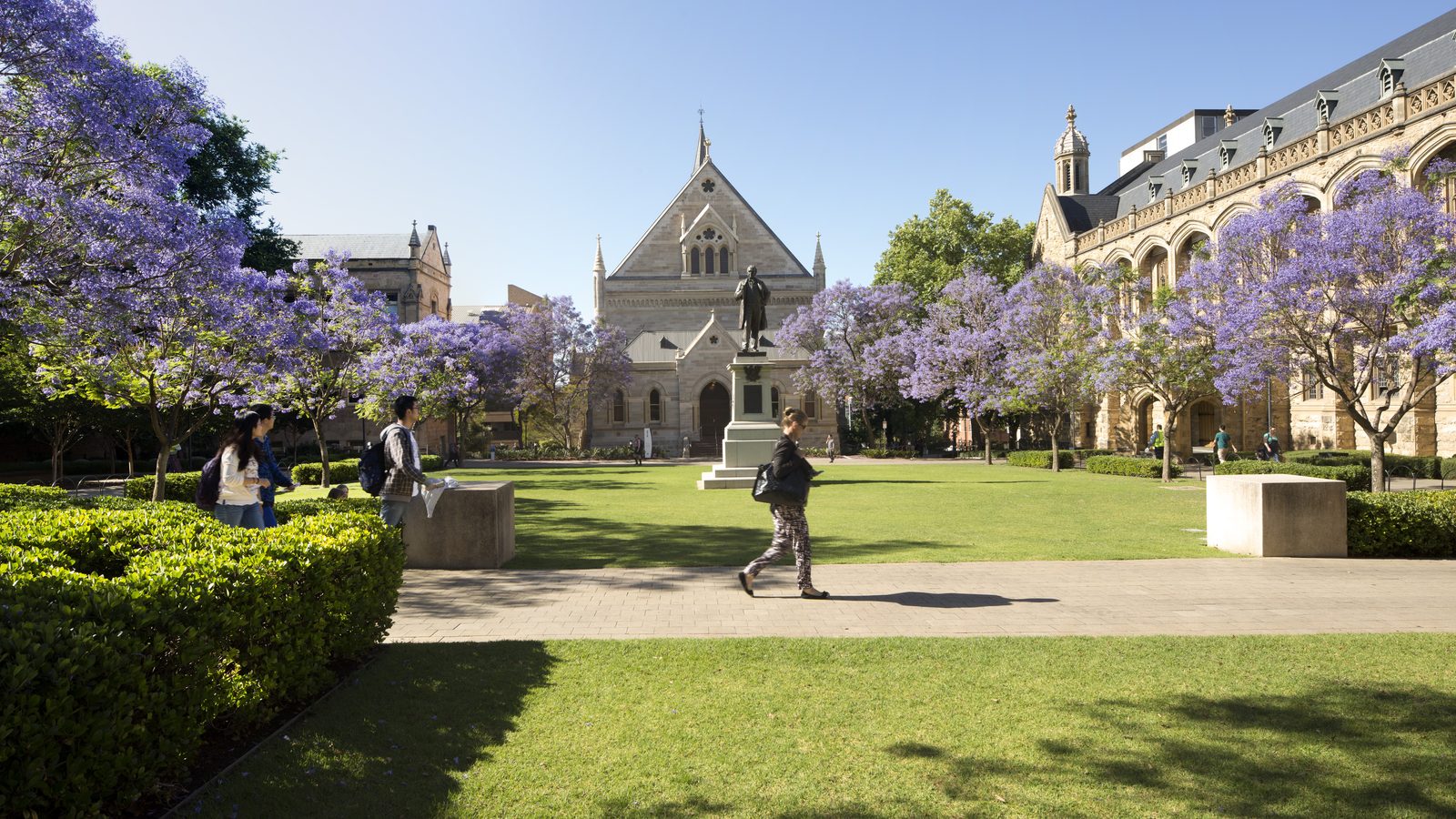
Study at AdelaideBegin in late February and complete the Bachelor of Laws (Honours) coursework in Adelaide, alongside Australian and international classmates.
Two and a half years, or the full four from Grade 12
Then MontréalYour final term if you entered with a degree already, or straight after the four years from Grade 12. Taught entirely in English, no French requirement. Covers Canadian constitutional law, Quebec civil law, and the foundations of Canadian and Indigenous law.
September to April
Come home readyAustralian law degree in hand and NCA requirements satisfied, in the same position as a classmate who stayed in Canada.
Three years with a degree, four years and eight months from Grade 12
Both Adelaide and Université de Montréal put this arrangement to the NCA independently. Both were told the transcript satisfies the requirements.
The optional fourth credential
Stay in Montréal four months beyond April and you can convert the diploma into a Master of Laws in Comparative Common Law. Three credentials, in a little over the time the degree takes on its own.
Two ways in, and no LSAT either way
Adelaide does not require the LSAT. This is not a lower bar, it is a different admissions philosophy. Australian law schools assess you on your academic record rather than a single test day, which is why the entry routes look unfamiliar to Canadians.
Straight from high schoolAustralia treats law as an undergraduate degree. You can enter the Bachelor of Laws (Honours) directly after Grade 12, without first completing a separate undergraduate degree.
After a degree you already haveIf you hold a completed undergraduate degree, the program shortens. You enter with advanced standing and finish in less time than a Canadian JD would take you.
Is Adelaide Law School any good?
Reasonable question, and the honest answer is yes, verifiably.
Adelaide Law School is ranked 63rd in the world for Law and Legal Studies in the QS World University Rankings by Subject 2026. For context, only three Canadian law schools place in the global top 100: Toronto, UBC, and McGill.
It is also the second oldest law school in Australia, established in 1883, and one of the oldest continuously operating common law schools anywhere. In the Australian government’s research assessment it has been rated above world standard, one of only seven of the country’s forty law schools to hold that rating continuously.
Its recognised strengths include international law and space law, where it is a genuine world leader, along with environmental and natural resources law, constitutional and public law, corporate and insolvency law, and health and medical law.
About Adelaide University
Adelaide University is a new kind of university shaped by a mission to strengthen society through education, research and innovation drawing on more than 180 years of achievement. We believe in the power of shared knowledge to uplift communities and accelerate progress as a comprehensive, for purpose institution with the scale to drive meaningful impact. As a leading, contemporary public university, we deliver nation leading curriculum, exceptional student experience and industry aligned research that advances South Australia and contributes globally.
Recognised for excellence across multiple disciplines, Adelaide University is ranked in the global top 50 in four subject areas, including Dentistry and Nursing*, and the global top 100 in 19 more^.
*Dentistry and Nursing ranked 49 and 50, QS World University Rankings By Subject 2026
^Aggregate of THE World University Rankings By Subject 2026 and QS World University Rankings By Subject 2026
What it costs
Studying abroad is not cheap, and we are not going to pretend otherwise. But the arithmetic here is better than it first looks, for two reasons.
You pay Australian international fees for one semester less than the degree runs. The Montréal program is billed by Université de Montréal at the Canadian rate for citizens studying outside Quebec, which is a fraction of what an international semester in Australia costs.
And you skip the NCA examination fees entirely, along with the year or more of lost earnings that comes with sitting them.
Entrance scholarships of 15%, 25% and 50% are available on either route. The 15% is guaranteed at roughly a 70% Canadian average and the 25% at roughly 90%, both assessed automatically when you apply through KOM.
For parents reading over a shoulder
The two questions we hear most often from parents are whether the degree is real and whether the pathway home is real. Both are fair.
Adelaide University is a member of the Group of Eight, Australia’s leading research universities. The Montréal arrangement is with a Canadian law faculty ranked in the world’s top 100. And KOM has been the official Canadian application centre for our partner universities since 1991, funded by the universities rather than by families, which is why our service costs you nothing.
We handle the logistics: the application, the GPA conversion, visa guidance, accommodation, and pre-departure orientation. You are not sending your child into this alone, and neither are we.
What you get that a spreadsheet will not show you
- Two legal systems, not oneYou study Australian common law, then Canadian and Quebec law in Montréal. Very few Canadian graduates can say they have worked inside two legal traditions before they start practising, and it changes how you read a problem.
- Years of living somewhere, not visiting itA term abroad is a holiday with reading. Two and a half years, or four, is different. You build a life, a routine and friendships on the other side of the world, and you come home having proved to yourself that you can.
- A profile that stands out on a CVEvery applicant for an articling position has a law degree. Rather fewer have navigated a visa, a move and an unfamiliar legal system before their first interview. Employers notice resilience and adaptability because they are hard to teach.
- A different view of the law itselfStudying somewhere else makes the assumptions of home visible. You stop treating the Canadian way of doing things as the only way, which is a useful habit in a profession built on argument.
None of this is a reason to ignore the cost, and we will not pretend otherwise. It is a reason to weigh more than the cost.
Where to start
If you are weighing this seriously, the guides below go deeper on each piece. If you would rather just talk it through, that is free too.
The Adelaide and Montréal Pathway: NCA Requirements Without the Challenge Exams
The arrangement with Université de Montréal, where it sits on each entry route, and why the NCA signed off on it twice.
Read the guide →
How Long It Takes to Be Ready for Licensing in Canada
Three years with a degree, four plus Montréal from Grade 12, against about seven in Canada. And what the missing year is worth.
Read the guide →
Adelaide Law School Entry Requirements for Canadian Students
How Adelaide assesses a Canadian application, the two routes in, and what your transcript needs to show.
Read the guide →
LLB vs JD: What the Difference Means for a Canadian Career
Canada awarded LLBs until the 2000s. The switch was a renaming, not a curriculum change.
Read the guide →
Law After Grade 12 or After a Degree: Which Entry Route Is Right for You
Four years from Grade 12 or three with a degree. The time, the money, and the one risk nobody prices.
Read the guide →
Ranked 63rd in the World: How Adelaide Law Compares to Canadian Law Schools
Only three Canadian law schools rank above it. What that number measures, what it does not, and what the merger changed.
Read the guide →
What an Adelaide Law Degree Costs a Canadian, Start to Finish
Published figures from all three institutions, in both currencies, including the bill you never receive.
Read the guide →
How Australian Law Degrees Differ for Canadian Licensing
Every Australian law degree ends at the NCA. How the schools differ on the part that decides when you can practise.
Read the guide →
Living and Studying in Adelaide: The Honest Version
Cheaper than Sydney and Melbourne, and smaller than both. Including the drawbacks.
Read the guide →
Space Law, International Law and What You Study at Adelaide
Space law, international law, environmental and resources law. What the school is unusually good at, and why it matters in Canada.
Read the guide →Adelaide University: Australian University Provider Number PRV14404 / CRICOS Provider Number 04249J