


If you are a Canadian university graduate with dreams of becoming a lawyer, you are likely staring down a very long, very expensive tunnel.
In Canada, the path usually looks like this:
- Finish a 4-year undergraduate degree.
- Spend 6–12 months studying for (and stressing over) the LSAT.
- Fight for a seat in a hyper-competitive Canadian JD program.
- Spend another 3 years in law school.
Total Time: 7 to 8 years.
But what if you could skip the LSAT entirely, keep your current undergraduate momentum going, and graduate with a world-class law degree in just two years?
This isn’t a “loophole.” It’s a strategic career move chosen by hundreds of Canadians every year. By studying in the UK or Australia, you can utilize your existing degree to enter a Graduate Entry LLB (senior status) program.
Here is why the “international route” is becoming the “smart route” for future Canadian lawyers.
The “Time Tax”
The biggest advantage of studying law abroad isn’t just the adventure (though living near the beach in Australia or a castle in Scotland is a nice bonus). It’s the ROI on your time.
Because the legal systems in the UK and Australia are the foundations of Canadian Common Law, universities there offer specialized “accelerated” degrees for students who already hold a Bachelor’s degree from Canada.
- Canada: 3 Years (JD) + LSAT Prep time
- UK/Australia: 2 Years (LLB) + No LSAT
By graduating a full year earlier, you enter the workforce a year earlier. That’s one extra year of earning a lawyer’s salary instead of paying tuition.
Where Should You Go? The “Big Three” Options
At KOM Educational Consultants, we work with nearly a dozen law schools. However, three universities consistently stand out for their popularity with Canadian students and their robust support systems.
1. The “Canadian Hub” of Australia: Bond University
Located on the sunny Gold Coast, Bond University is legendary among Canadian lawyers. Why? Because they run on a three-semester-per-year system. This intensity allows you to complete a standard law degree faster than almost anywhere else in the world.
- The Vibe: Palm trees, modern campus, small class sizes.
- The Advantage: Bond offers four Canadian Law electives specifically designed to help you prepare for your return. They know exactly what you need because they’ve been training Canadians for decades.
- Learn More: Bond University Law Program
2. The Public Powerhouse: Griffith University
Also located in Queensland, Griffith University is a massive, world-ranked public institution. They offer a highly respected graduate-entry law program that attracts students seeking the “big university” experience and global recognition.
- The Vibe: Diverse, energetic, and integrated into the vibrant Gold Coast/Brisbane corridor.
- The Advantage: Griffith’s Law School is ranked in the top 50 worldwide. You aren’t just getting a degree; you’re getting a prestigious credential.
- Learn More: Griffith University Law
3. The UK Route: Bangor University
If heat and humidity aren’t your preference, consider Wales. Bangor University offers a 2-year accelerated LLB that is significantly more cost-effective than studying in London or Sydney.
- The Vibe: Historic, academic, and incredibly welcoming. Bangor is a student-centric city where your dollar (or Pound) goes much further.
- The Advantage: English law has unique parallels to Canadian law, and Bangor’s options can be a massive asset if you have international career ambitions.
- Learn More: Bangor University Law
For families concerned about logistics, read our parents’ guide to safety and housing in the UK and Australia.
The “Elephant in the Room”: Returning to Canada
Let’s address the fear every parent has: “Is this degree real? Can I actually practice in Canada?”
The Answer: Yes.
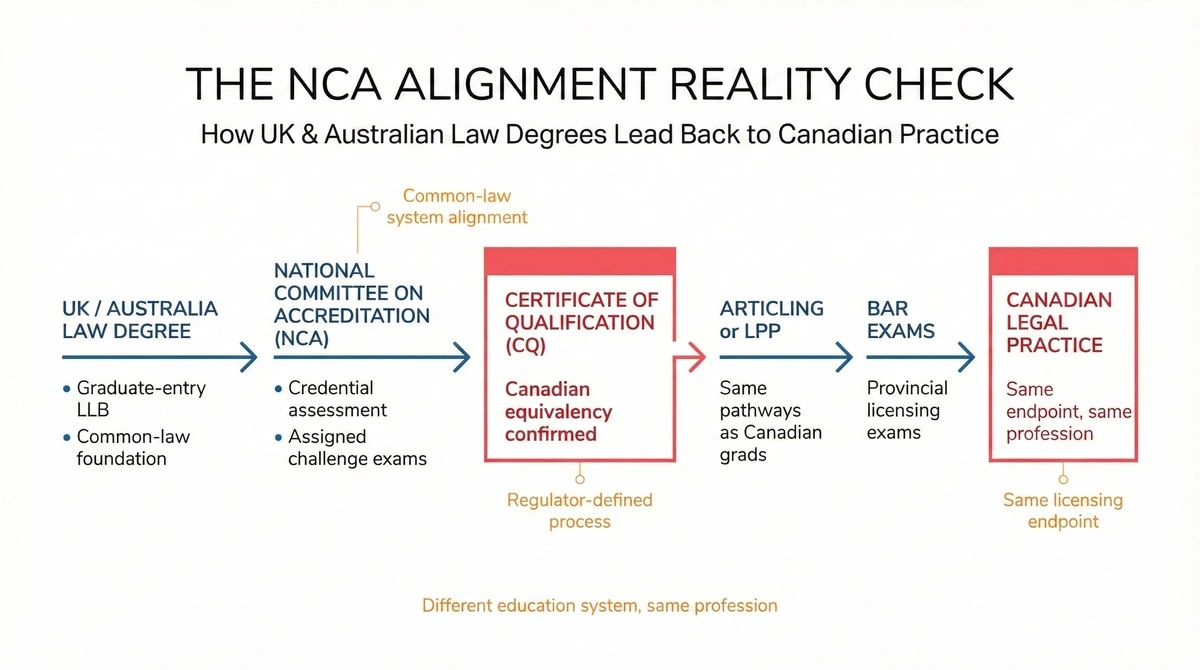
When you return to Canada with a law degree from the UK or Australia, you must go through a process with the National Committee on Accreditation (NCA).
The NCA assesses your foreign degree and assigns you “challenge exams” to ensure you know specific Canadian content (like Canadian Constitutional Law or Criminal Law).
- You graduate from Bond, Griffith, or Bangor.
- You apply to the NCA.
- You take the assigned exams (self-study).
- You receive your Certificate of Qualification (CQ).
Once you have your CQ, you are in the exact same position as a graduate from U of T or Dalhousie. You proceed to your Articling, LPP, and Bar Exams just like everyone else.
Read the official NCA Assessment Guidelines here.
Returning to practice is straightforward. Learn more about the NCA accreditation steps for Canadian lawyers.
Is This Path Right For You?
If you are willing to spend six months studying logic games for the LSAT and fighting for a seat in Ontario, the domestic route is fine.
But if you are ready to start your career now, skip the standardized tests and gain global experience that sets you apart in job interviews. The international route is waiting.
Applications for the upcoming intakes are open now. Because KOM is the official application center, we can often waive your application fees and fast-track your assessment. Explore all law schools and apply for free.
Disclaimer: Content on KOM Educational Consultant’s blog is for informational purposes. Admissions criteria, tuition fees, and licensing requirements (e.g., CAPR, NCA, OCT) are subject to change by the respective universities and regulatory bodies. Always verify the latest information directly with your KOM consultant or the official regulator.